Wednesday, 27 August 2014

[M956.Ebook] PDF Ebook Adele - 25, Piano/Vocal/Guitar, by Adele

PDF Ebook Adele - 25, Piano/Vocal/Guitar, by Adele

This letter could not affect you to be smarter, but guide Adele - 25, Piano/Vocal/Guitar, By Adele that we offer will certainly stimulate you to be smarter. Yeah, at the very least you'll understand greater than others which do not. This is just what called as the quality life improvisation. Why ought to this Adele - 25, Piano/Vocal/Guitar, By Adele It's due to the fact that this is your preferred motif to review. If you such as this Adele - 25, Piano/Vocal/Guitar, By Adele style about, why don't you review guide Adele - 25, Piano/Vocal/Guitar, By Adele to improve your discussion?

Adele - 25, Piano/Vocal/Guitar, by Adele

Adele - 25, Piano/Vocal/Guitar, by Adele


Adele - 25, Piano/Vocal/Guitar, by Adele

PDF Ebook Adele - 25, Piano/Vocal/Guitar, by Adele

Adele - 25, Piano/Vocal/Guitar, By Adele. Let's read! We will certainly frequently discover out this sentence all over. When still being a kid, mama made use of to order us to consistently read, so did the instructor. Some publications Adele - 25, Piano/Vocal/Guitar, By Adele are fully read in a week and we need the responsibility to assist reading Adele - 25, Piano/Vocal/Guitar, By Adele What around now? Do you still love reading? Is reading simply for you who have obligation? Never! We below provide you a brand-new publication entitled Adele - 25, Piano/Vocal/Guitar, By Adele to read.

As we stated previously, the modern technology aids us to consistently realize that life will certainly be constantly much easier. Reviewing publication Adele - 25, Piano/Vocal/Guitar, By Adele behavior is likewise one of the benefits to obtain today. Why? Technology can be made use of to give the book Adele - 25, Piano/Vocal/Guitar, By Adele in only soft data system that can be opened every time you want as well as almost everywhere you require without bringing this Adele - 25, Piano/Vocal/Guitar, By Adele prints in your hand.

Those are several of the advantages to take when obtaining this Adele - 25, Piano/Vocal/Guitar, By Adele by online. But, exactly how is the means to get the soft data? It's very appropriate for you to visit this page considering that you could obtain the link web page to download and install guide Adele - 25, Piano/Vocal/Guitar, By Adele Just click the web link supplied in this short article as well as goes downloading. It will not take much time to obtain this publication Adele - 25, Piano/Vocal/Guitar, By Adele, like when you need to go with publication store.

This is also one of the factors by obtaining the soft data of this Adele - 25, Piano/Vocal/Guitar, By Adele by online. You might not require even more times to invest to see the e-book establishment and also look for them. In some cases, you also don't locate the e-book Adele - 25, Piano/Vocal/Guitar, By Adele that you are browsing for. It will throw away the time. However below, when you visit this web page, it will certainly be so easy to obtain and also download and install the book Adele - 25, Piano/Vocal/Guitar, By Adele It will certainly not take many times as we explain before. You could do it while doing another thing in the house or perhaps in your workplace. So easy! So, are you doubt? Just practice exactly what we supply right here and also check out Adele - 25, Piano/Vocal/Guitar, By Adele what you enjoy to check out!

Adele - 25, Piano/Vocal/Guitar, by Adele

(Piano/Vocal/Guitar Artist Songbook). Our matching songbook to Adele's much-anticipated and record-smashing 2015 album features piano/vocal/guitar arrangements of all its tracks including the first instant hit single "Hello" and nine others.

  • Sales Rank: #36321 in Books
  • Brand: Hal Leonard
  • Published on: 2015-12-01
  • Original language: English
  • Dimensions: 12.00" h x .21" w x 9.00" l, .0 pounds
  • Binding: Paperback
  • 72 pages

Most helpful customer reviews

15 of 15 people found the following review helpful.
Mostly good arrangements of all songs from '25'
By R. Morris
In general, this book is about what you would expect: it contains piano transcriptions of every song from 25, along with the vocal line and guitar chords. Like much of Adele's music, most songs on this album are quite piano-heavy, so I had high hopes for the transcriptions being authentic. Mostly, this is true. For example, "All I Ask" is absolutely beautiful and sounds almost spot-on to the album recording. It is my favorite piece from both the album and this book, and you won't be disappointed with it. "When We Were Young" is decent, but when the album recording has both the piano and bass, the transcription in this book has only the piano part--you're missing the little bass runs that I think make the song a bit more exciting (and, no matter how stunningly performed the song may be, the instrumentals are very simple and you can probably do just as good as this transcription just by looking at the chord progression and faking it if you don't care about the bass; I was able to find a transcription I liked better as a digital download on a well-known online sheet music store). Finally, her first hit from the album, "Hello," is quite poorly transcribed if you're just looking for the accompaniment: on this piece, they decided to put the melody into the piano part. It's mostly easy ignore if you're a capable enough player to filter it out, but to play it like that requires more effort and ruins what could have otherwise been a great transcription of a beautiful song. Finally, there are a couple songs that just don't work as well on the piano (ones without a prominent piano part in the album itself), but I wasn't as interested in those anyway.

I'm deducting one star for the aforementioned reasons: some otherwise good transcriptions are mysteriously missing something that would make them more authentic, and some "accompaniment" lines are transcribed with the melody (but at least the whole book doesn't consistently do that). In general, the book is well done, and it does include all songs from the album with reasonably good transcriptions of most of them.

4 of 4 people found the following review helpful.
Advanced level
By AvidRiet
Note to the publishers: Please let us look inside the book before we buy! It's so hard to judge if the music is at your level before even looking at it. I'm disappointed that many of these songs are a bit above my intermediate skill level. I would have easily known that by looking through the pages for 2 minutes.

The easiest songs to play are "Sweetest Devotion" in the key of C, and "Send my Love" in the key of D. If you are like me, and aren't going to spend a lot of time practicing the more difficult songs, I would buy those separately.

1 of 1 people found the following review helpful.
... way that an intermediate player such as myself could enjoy the music
By JCT
The arrangements were done in a way that an intermediate player such as myself could enjoy the music, though I believe an advanced player would enjoy the songs as well. Though I can't say I'm a rabid fan to the point of buying concert tickets in the first 10 minutes before they're sold out, I do appreciate the beauty of her music, and this another way that I'm able to enjoy it.

See all 19 customer reviews...

Adele - 25, Piano/Vocal/Guitar, by Adele PDF
Adele - 25, Piano/Vocal/Guitar, by Adele EPub
Adele - 25, Piano/Vocal/Guitar, by Adele Doc
Adele - 25, Piano/Vocal/Guitar, by Adele iBooks
Adele - 25, Piano/Vocal/Guitar, by Adele rtf
Adele - 25, Piano/Vocal/Guitar, by Adele Mobipocket
Adele - 25, Piano/Vocal/Guitar, by Adele Kindle

Adele - 25, Piano/Vocal/Guitar, by Adele PDF

Adele - 25, Piano/Vocal/Guitar, by Adele PDF

Adele - 25, Piano/Vocal/Guitar, by Adele PDF

Wednesday, 20 August 2014

[K321.Ebook] Fee Download Dungeons and Dragons Set No. 3: Companion Rules [Boxed Set], by Tsr

Fee Download Dungeons and Dragons Set No. 3: Companion Rules [Boxed Set], by Tsr

Dungeons And Dragons Set No. 3: Companion Rules [Boxed Set], By Tsr. In what case do you like reading so much? What regarding the kind of guide Dungeons And Dragons Set No. 3: Companion Rules [Boxed Set], By Tsr The demands to check out? Well, everybody has their own reason needs to review some publications Dungeons And Dragons Set No. 3: Companion Rules [Boxed Set], By Tsr Mostly, it will associate to their necessity to obtain expertise from the e-book Dungeons And Dragons Set No. 3: Companion Rules [Boxed Set], By Tsr and also wish to read merely to obtain entertainment. Books, story e-book, as well as various other amusing books end up being so prominent this day. Besides, the clinical e-books will certainly also be the very best need to select, especially for the students, educators, physicians, entrepreneur, as well as other professions which are fond of reading.

Dungeons and Dragons Set No. 3: Companion Rules [Boxed Set], by Tsr

Dungeons and Dragons Set No. 3: Companion Rules [Boxed Set], by Tsr


Dungeons and Dragons Set No. 3: Companion Rules [Boxed Set], by Tsr

Fee Download Dungeons and Dragons Set No. 3: Companion Rules [Boxed Set], by Tsr

Book lovers, when you require a new book to read, discover guide Dungeons And Dragons Set No. 3: Companion Rules [Boxed Set], By Tsr here. Never ever worry not to find what you need. Is the Dungeons And Dragons Set No. 3: Companion Rules [Boxed Set], By Tsr your required book currently? That holds true; you are truly an excellent viewers. This is a best book Dungeons And Dragons Set No. 3: Companion Rules [Boxed Set], By Tsr that originates from great author to show you. The book Dungeons And Dragons Set No. 3: Companion Rules [Boxed Set], By Tsr offers the very best encounter as well as lesson to take, not just take, yet also find out.

Keep your way to be below and read this page finished. You could delight in browsing the book Dungeons And Dragons Set No. 3: Companion Rules [Boxed Set], By Tsr that you actually refer to obtain. Right here, getting the soft file of the book Dungeons And Dragons Set No. 3: Companion Rules [Boxed Set], By Tsr can be done quickly by downloading and install in the link web page that we supply right here. Naturally, the Dungeons And Dragons Set No. 3: Companion Rules [Boxed Set], By Tsr will be all yours sooner. It's no need to get ready for the book Dungeons And Dragons Set No. 3: Companion Rules [Boxed Set], By Tsr to get some days later on after acquiring. It's no have to go outside under the heats at center day to head to guide establishment.

This is several of the advantages to take when being the member and also get the book Dungeons And Dragons Set No. 3: Companion Rules [Boxed Set], By Tsr here. Still ask exactly what's different of the various other site? We supply the hundreds titles that are developed by recommended authors and also publishers, around the world. The connect to purchase and download and install Dungeons And Dragons Set No. 3: Companion Rules [Boxed Set], By Tsr is likewise very simple. You might not discover the complicated website that order to do even more. So, the way for you to get this Dungeons And Dragons Set No. 3: Companion Rules [Boxed Set], By Tsr will be so simple, will not you?

Based upon the Dungeons And Dragons Set No. 3: Companion Rules [Boxed Set], By Tsr details that we offer, you may not be so confused to be right here as well as to be participant. Get currently the soft file of this book Dungeons And Dragons Set No. 3: Companion Rules [Boxed Set], By Tsr and wait to be all yours. You saving could lead you to evoke the ease of you in reading this book Dungeons And Dragons Set No. 3: Companion Rules [Boxed Set], By Tsr Also this is types of soft data. You can truly make better opportunity to obtain this Dungeons And Dragons Set No. 3: Companion Rules [Boxed Set], By Tsr as the suggested book to read.

Dungeons and Dragons Set No. 3: Companion Rules [Boxed Set], by Tsr

Dungeons & Dragons Set 3: Companion Rules includes two booklets. * Players Companion - Featuring rules for unarmed combat, strongholds, and new weapons and armor. Plus more advanced rules and spells or your characters. * Dungeon Masters Companion - New rules or ruling realms and the clash of kingdoms. New treasures and monsters. Plus new adventures for your high-level characters."

  • Sales Rank: #1642105 in Books
  • Published on: 1984-07
  • Original language: English
  • Dimensions: 1.20 pounds
  • Binding: Paperback

Most helpful customer reviews

0 of 1 people found the following review helpful.
Supplement for D&D
By George E. Duffy Jr.
D&D, before AD&D where the basics started. Nice add on to D&D basic and D&D expert set. Able to fill out your characters better.

0 of 1 people found the following review helpful.
Four Stars
By el
The product was delivered with an unexpected celerity (7 day long) and in adequation with the quality described

0 of 1 people found the following review helpful.
Five Stars
By Vernon E. McBride
Love this game...

See all 3 customer reviews...

Dungeons and Dragons Set No. 3: Companion Rules [Boxed Set], by Tsr PDF
Dungeons and Dragons Set No. 3: Companion Rules [Boxed Set], by Tsr EPub
Dungeons and Dragons Set No. 3: Companion Rules [Boxed Set], by Tsr Doc
Dungeons and Dragons Set No. 3: Companion Rules [Boxed Set], by Tsr iBooks
Dungeons and Dragons Set No. 3: Companion Rules [Boxed Set], by Tsr rtf
Dungeons and Dragons Set No. 3: Companion Rules [Boxed Set], by Tsr Mobipocket
Dungeons and Dragons Set No. 3: Companion Rules [Boxed Set], by Tsr Kindle

Dungeons and Dragons Set No. 3: Companion Rules [Boxed Set], by Tsr PDF

Dungeons and Dragons Set No. 3: Companion Rules [Boxed Set], by Tsr PDF

Dungeons and Dragons Set No. 3: Companion Rules [Boxed Set], by Tsr PDF

Tuesday, 19 August 2014

[Y282.Ebook] PDF Download Critical Security Studies: An Introduction, by Columba Peoples, Nick Vaughan-Williams

PDF Download Critical Security Studies: An Introduction, by Columba Peoples, Nick Vaughan-Williams

Do you understand why you need to review this website and also just what the connection to reviewing publication Critical Security Studies: An Introduction, By Columba Peoples, Nick Vaughan-Williams In this modern period, there are lots of ways to obtain the publication and they will be considerably easier to do. One of them is by getting the book Critical Security Studies: An Introduction, By Columba Peoples, Nick Vaughan-Williams by online as what we inform in the web link download. The book Critical Security Studies: An Introduction, By Columba Peoples, Nick Vaughan-Williams can be a selection considering that it is so appropriate to your need now. To obtain guide online is very simple by simply downloading them. With this opportunity, you can review guide any place and whenever you are. When taking a train, awaiting list, and also hesitating for someone or various other, you could review this on the internet book Critical Security Studies: An Introduction, By Columba Peoples, Nick Vaughan-Williams as a good pal again.

Critical Security Studies: An Introduction, by Columba Peoples, Nick Vaughan-Williams

Critical Security Studies: An Introduction, by Columba Peoples, Nick Vaughan-Williams


Critical Security Studies: An Introduction, by Columba Peoples, Nick Vaughan-Williams

PDF Download Critical Security Studies: An Introduction, by Columba Peoples, Nick Vaughan-Williams

This is it the book Critical Security Studies: An Introduction, By Columba Peoples, Nick Vaughan-Williams to be best seller recently. We provide you the most effective deal by obtaining the spectacular book Critical Security Studies: An Introduction, By Columba Peoples, Nick Vaughan-Williams in this site. This Critical Security Studies: An Introduction, By Columba Peoples, Nick Vaughan-Williams will certainly not only be the type of book that is challenging to find. In this internet site, all types of books are provided. You could search title by title, author by author, and also author by author to find out the most effective book Critical Security Studies: An Introduction, By Columba Peoples, Nick Vaughan-Williams that you could check out currently.

As we explained previously, the innovation assists us to consistently identify that life will be always much easier. Reading book Critical Security Studies: An Introduction, By Columba Peoples, Nick Vaughan-Williams behavior is also among the perks to obtain today. Why? Technology could be used to supply guide Critical Security Studies: An Introduction, By Columba Peoples, Nick Vaughan-Williams in only soft documents system that could be opened up every time you want and everywhere you need without bringing this Critical Security Studies: An Introduction, By Columba Peoples, Nick Vaughan-Williams prints in your hand.

Those are some of the advantages to take when obtaining this Critical Security Studies: An Introduction, By Columba Peoples, Nick Vaughan-Williams by on-line. Yet, just how is the means to obtain the soft data? It's quite best for you to visit this web page since you can get the link page to download and install guide Critical Security Studies: An Introduction, By Columba Peoples, Nick Vaughan-Williams Just click the link provided in this write-up and goes downloading. It will certainly not take much time to obtain this e-book Critical Security Studies: An Introduction, By Columba Peoples, Nick Vaughan-Williams, like when you have to opt for e-book shop.

This is likewise among the reasons by getting the soft file of this Critical Security Studies: An Introduction, By Columba Peoples, Nick Vaughan-Williams by online. You may not need even more times to spend to go to the book establishment and search for them. Sometimes, you also do not locate the publication Critical Security Studies: An Introduction, By Columba Peoples, Nick Vaughan-Williams that you are looking for. It will certainly lose the moment. But right here, when you see this page, it will certainly be so very easy to get and download guide Critical Security Studies: An Introduction, By Columba Peoples, Nick Vaughan-Williams It will certainly not take lots of times as we state before. You could do it while doing something else at residence and even in your office. So simple! So, are you doubt? Merely practice what we provide right here and review Critical Security Studies: An Introduction, By Columba Peoples, Nick Vaughan-Williams just what you like to read!

Critical Security Studies: An Introduction, by Columba Peoples, Nick Vaughan-Williams

Critical Security Studies introduces students to the sub-field through a detailed yet accessible survey of evolving approaches and key issues. This new edition contains two new chapters and has been fully revised and updated.

Written in an accessible and clear manner, Critical Security Studies:

  • offers a comprehensive and up-to-date introduction to critical security studies
  • locates critical security studies within the broader context of social and political theory
  • evaluates fundamental theoretical positions within critical security studies in application to key issues.

The book is divided into two main parts. The first part, ‘Approaches’, surveys the newly extended and contested theoretical terrain of critical security studies: Critical Theory, Feminism and gender theory, Postcolonialism, Poststructuralism and Securitization theory. The second part, ‘Issues’, then illustrates these various theoretical approaches against the backdrop of a diverse range of issues in contemporary security practices, from environmental, human and homeland security to border security, technology and warfare, and the War against Terrorism. This edition also includes new chapters on Constructivist theories (Part I) and health (Part II).

The historical and geographical scope of the book is deliberately broad and readers are introduced to a number of key illustrative case studies. Each of the chapters in Part II concretely illustrate one or more of the approaches discussed in Part I, with clear internal referencing allowing the text to act as a holistic learning tool for students.

This book is essential reading for upper-level students of Critical Security Studies, and an important resource for students of International/Global Security, Political Theory and International Relations.

  • Sales Rank: #1707227 in Books
  • Published on: 2014-08-07
  • Released on: 2014-07-28
  • Original language: English
  • Number of items: 1
  • Dimensions: 9.69" h x .54" w x 6.85" l, 1.08 pounds
  • Binding: Paperback
  • 236 pages

Review

‘I use Critical Security Studies as a required reading for my courses in Paris and London ― it is in my view the best introduction to the topic and this second edition is very welcome.’ -- Didier Bigo, King’s College London, UK

‘Combining breadth and accessibility with cutting-edge contributions, the second edition of this book provides an excellent overview of critical security studies today.’ -- Michael C. Williams, University of Ottawa, Canada

'This second edition gives us a most welcome update of what remains a key introduction to critical security studies. It is great to see the most recent developments in this vibrant field of research included.' -- Jef Huysmans, Open University, UK

'In mapping the recent advances and debates in the vibrant field of critical security studies, this book will be crucially important to students and scholars alike. Critical Security Studies: An Introduction highlights a different topography of critical approaches to security, which is more complex, layered and messy than existing maps have allowed us to see. The book is thus more than an introduction to the field - it is an injunction to rethink the political-theoretical underpinnings in critical approaches and take the debates further.'-- Claudia Aradau, King's College London, UK

About the Author

Columba Peoples is Senior Lecturer in International Relations in the School of Sociology, Politics and International Studies at the University of Bristol and author of Justifying Ballistic Missile Defence (2010).

Nick Vaughan-Williams is Reader�in International Security in the Department of Politics and International Studies at the University of Warwick, and author of Border Politics: The Limits of Sovereign Power (2009).�

Most helpful customer reviews

See all customer reviews...

Critical Security Studies: An Introduction, by Columba Peoples, Nick Vaughan-Williams PDF
Critical Security Studies: An Introduction, by Columba Peoples, Nick Vaughan-Williams EPub
Critical Security Studies: An Introduction, by Columba Peoples, Nick Vaughan-Williams Doc
Critical Security Studies: An Introduction, by Columba Peoples, Nick Vaughan-Williams iBooks
Critical Security Studies: An Introduction, by Columba Peoples, Nick Vaughan-Williams rtf
Critical Security Studies: An Introduction, by Columba Peoples, Nick Vaughan-Williams Mobipocket
Critical Security Studies: An Introduction, by Columba Peoples, Nick Vaughan-Williams Kindle

Critical Security Studies: An Introduction, by Columba Peoples, Nick Vaughan-Williams PDF

Critical Security Studies: An Introduction, by Columba Peoples, Nick Vaughan-Williams PDF

Critical Security Studies: An Introduction, by Columba Peoples, Nick Vaughan-Williams PDF

Sunday, 17 August 2014

[L753.Ebook] Download PDF Vector & Tensor Analysis With Applications, by A I Borisenko, I.E. Tarapov

Download PDF Vector & Tensor Analysis With Applications, by A I Borisenko, I.E. Tarapov

Nonetheless, reading guide Vector & Tensor Analysis With Applications, By A I Borisenko, I.E. Tarapov in this website will lead you not to bring the printed book almost everywhere you go. Simply store the book in MMC or computer system disk as well as they are offered to read at any time. The flourishing system by reading this soft documents of the Vector & Tensor Analysis With Applications, By A I Borisenko, I.E. Tarapov can be introduced something brand-new practice. So now, this is time to prove if reading could boost your life or not. Make Vector & Tensor Analysis With Applications, By A I Borisenko, I.E. Tarapov it undoubtedly work and get all advantages.

Vector & Tensor Analysis With Applications, by A I Borisenko, I.E. Tarapov

Vector & Tensor Analysis With Applications, by A I Borisenko, I.E. Tarapov


Vector & Tensor Analysis With Applications, by A I Borisenko, I.E. Tarapov

Download PDF Vector & Tensor Analysis With Applications, by A I Borisenko, I.E. Tarapov

Vector & Tensor Analysis With Applications, By A I Borisenko, I.E. Tarapov. Eventually, you will uncover a brand-new adventure and also knowledge by spending more money. However when? Do you believe that you need to acquire those all needs when having much money? Why don't you attempt to get something straightforward at initial? That's something that will lead you to know more concerning the globe, adventure, some locations, past history, amusement, as well as much more? It is your personal time to continue reviewing routine. Among the books you could enjoy now is Vector & Tensor Analysis With Applications, By A I Borisenko, I.E. Tarapov here.

Right here, we have countless e-book Vector & Tensor Analysis With Applications, By A I Borisenko, I.E. Tarapov and also collections to review. We likewise offer alternative types and type of the publications to look. The enjoyable e-book, fiction, history, unique, science, and various other sorts of books are offered below. As this Vector & Tensor Analysis With Applications, By A I Borisenko, I.E. Tarapov, it becomes one of the preferred publication Vector & Tensor Analysis With Applications, By A I Borisenko, I.E. Tarapov collections that we have. This is why you remain in the right site to view the outstanding publications to possess.

It won't take even more time to download this Vector & Tensor Analysis With Applications, By A I Borisenko, I.E. Tarapov It won't take even more money to publish this publication Vector & Tensor Analysis With Applications, By A I Borisenko, I.E. Tarapov Nowadays, people have actually been so clever to utilize the technology. Why don't you use your gizmo or various other device to conserve this downloaded soft documents e-book Vector & Tensor Analysis With Applications, By A I Borisenko, I.E. Tarapov This method will certainly let you to consistently be gone along with by this book Vector & Tensor Analysis With Applications, By A I Borisenko, I.E. Tarapov Naturally, it will be the most effective pal if you review this publication Vector & Tensor Analysis With Applications, By A I Borisenko, I.E. Tarapov until completed.

Be the first to obtain this book now and obtain all reasons you require to read this Vector & Tensor Analysis With Applications, By A I Borisenko, I.E. Tarapov The e-book Vector & Tensor Analysis With Applications, By A I Borisenko, I.E. Tarapov is not simply for your duties or requirement in your life. Books will always be a good close friend in each time you review. Now, allow the others recognize for this page. You could take the benefits and discuss it likewise for your good friends and individuals around you. By by doing this, you can truly obtain the definition of this book Vector & Tensor Analysis With Applications, By A I Borisenko, I.E. Tarapov profitably. Just what do you consider our concept right here?

Vector & Tensor Analysis With Applications, by A I Borisenko, I.E. Tarapov

Selected Russian Publications in the Mathematical Science

  • Sales Rank: #4420324 in Books
  • Published on: 1968
  • Original language: English
  • Number of items: 1
  • Binding: Hardcover
  • 257 pages

Most helpful customer reviews

54 of 56 people found the following review helpful.
Finally -- a clear explanation of tensors
By Kindle Customer
I was first exposed to tensors in college, and the experience was so unpleasant and bewildering that I switched to quantum mechanics. QM made sense to me; tensors did not.

Decades later, I had a real need for tensors in my job, so I had to learn them. I bought and read a half-dozen well-rated books from Amazon, but only this book worked. The exposition is mathematically rigorous, but the content is also well-motivated. Their explanation of "The Tensor Concept" is the subject of a dedicated chapter; it alone is worth the price of the book. Its presentation encapsulates the book's style, so I'll preview it here.

A standard, one-dimensional vector is a ray in space, with direction and length independent of the coordinate system. As the coordinate system changes (e.g. rotate and/or stretch the axes), the coordinate values change, but the vector is the same. (Indeed, that's how you figure out the new coordinate values!)

The most simple example of mapping one vector into another is multiplication by a two dimensional matrix. Here is the golden insight: if the input and output vectors are coordinate independent, then there must be some kind of coordinate-independent function that defines the mapping, and it is called a tensor. In short, a mixed rank-2 tensor is the coordinate independent version of a matrix.

They work through the transformation rules of a standard vector to establish notation, then work through the exact corresponding process to get the transformation rules for the matrix. Instead of just asserting that "A Tensor is something which transforms the following way", they start with the intuitive notion and present a simple derivation of the transformation rule. For example, they state up front that the reason why the tensor transforms is that there is a change in basis vectors. Some descriptions never mention what is causing the tensor to 'transform' -- they just assume you already know. An excellent precept of math education is "Never memorize, always re-derive" (because memorizing what you don't understand may get you through the next test, but it deprives one of the foundation necessary to get through the test after next). The presentation in this book follows that precept beautifully (e.g. starting at transformation of bases and deriving the transformation laws). The Soviets were famous for their mathematical education, and this book reflects the excellence of that educational approach.

Similarly, the dot product of two vectors defines a scalar. If the scalar is coordinate independent, then there must be a coordinate independent function from vectors to numbers. It is a different kind of rank-1 tensor. When they do the same basic derivation, the distinction between covariant and contravariant indicies becomes crystal clear. If the components of the vector are a "contravariant" tensor, then this "different kind" is a "covariant" tensor. They also explain the relationship between reciprocal basis systems, and illustrate in clear pictures why whatever is "covariant" in one system is "contravariant" in the other, and vice versa. So they finally made clear what was so confusing about "covariant" and "contravariant": there is no fundamental distinction, and it just depends on which arbitrary choice of coordinate system one makes.

That's the first 100 pages. The next 150 present the "applications" portion. Once the basic concept is clear, the rest is fairly straightforward algebra. Again, it is quite well presented, but the main value to me was the conceptual foundation.

29 of 31 people found the following review helpful.
A clear development of vector and tensor concepts.
By A Customer
I have a solid foundation in vector analysis, but never felt comfortable with tensors and generalized coordinates, yet these are necessary for much of modern physics. This book was an ideal fit for my background. It presented a clear and steady development of both tensor and vector concepts with illustrations and examples. Covariant and contravariant components, metrics, and generalized coordinates were developed alongside of orthogonal basis concepts. Then, after the first half of the book developed the tools, the second half of the book presented analysis covering such topics as Stokes and Gauss' theorem, finishing with the fundamental theorem of vector analysis. My only complaint is that the book ended where it did. A section on more advanced tensor concepts would have fit in nicely.

23 of 24 people found the following review helpful.
Dated, but well-written and complete
By Bernardo Vargas
This book is a translation from the Russian of a regarded text written in the 1960's. Taking this into account you cannot expect to find a state-of-the-art exposition of the subject. However, the book is written in a very concise and focused style, making it endurable. Its clear introduction to many delicate topics (covariant derivatives, metric tensors, geodesics, etc.) is still valuable even now when the differential form approach seems to have won the battle. Also, the sections it devotes to integral theorems look more in touch with current trends in mathematics than most of the classical texts at this level.

See all 9 customer reviews...

Vector & Tensor Analysis With Applications, by A I Borisenko, I.E. Tarapov PDF
Vector & Tensor Analysis With Applications, by A I Borisenko, I.E. Tarapov EPub
Vector & Tensor Analysis With Applications, by A I Borisenko, I.E. Tarapov Doc
Vector & Tensor Analysis With Applications, by A I Borisenko, I.E. Tarapov iBooks
Vector & Tensor Analysis With Applications, by A I Borisenko, I.E. Tarapov rtf
Vector & Tensor Analysis With Applications, by A I Borisenko, I.E. Tarapov Mobipocket
Vector & Tensor Analysis With Applications, by A I Borisenko, I.E. Tarapov Kindle

Vector & Tensor Analysis With Applications, by A I Borisenko, I.E. Tarapov PDF

Vector & Tensor Analysis With Applications, by A I Borisenko, I.E. Tarapov PDF

Vector & Tensor Analysis With Applications, by A I Borisenko, I.E. Tarapov PDF

Thursday, 14 August 2014

[I176.Ebook] PDF Ebook Sex and Religion in the Bible, by Calum Carmichael

PDF Ebook Sex and Religion in the Bible, by Calum Carmichael

When someone ought to visit guide stores, search establishment by establishment, rack by rack, it is really frustrating. This is why we give the book collections in this website. It will certainly relieve you to search the book Sex And Religion In The Bible, By Calum Carmichael as you like. By browsing the title, author, or writers of guide you desire, you can find them swiftly. At home, workplace, and even in your method can be all ideal location within net links. If you wish to download the Sex And Religion In The Bible, By Calum Carmichael, it is extremely easy then, considering that currently we proffer the connect to acquire and make deals to download Sex And Religion In The Bible, By Calum Carmichael So very easy!

Sex and Religion in the Bible, by Calum Carmichael

Sex and Religion in the Bible, by Calum Carmichael


Sex and Religion in the Bible, by Calum Carmichael

PDF Ebook Sex and Religion in the Bible, by Calum Carmichael

Sex And Religion In The Bible, By Calum Carmichael. The established technology, nowadays support everything the human requirements. It includes the day-to-day activities, works, office, enjoyment, as well as more. One of them is the fantastic website link as well as computer system. This problem will relieve you to assist one of your pastimes, reviewing behavior. So, do you have prepared to read this book Sex And Religion In The Bible, By Calum Carmichael now?

For everybody, if you wish to start accompanying others to review a book, this Sex And Religion In The Bible, By Calum Carmichael is much suggested. And also you have to get the book Sex And Religion In The Bible, By Calum Carmichael below, in the link download that we supply. Why should be here? If you desire other kind of books, you will certainly consistently discover them and Sex And Religion In The Bible, By Calum Carmichael Economics, politics, social, scientific researches, religions, Fictions, as well as a lot more publications are provided. These readily available publications are in the soft data.

Why should soft file? As this Sex And Religion In The Bible, By Calum Carmichael, many people additionally will should purchase guide sooner. Yet, occasionally it's up until now method to get guide Sex And Religion In The Bible, By Calum Carmichael, also in various other nation or city. So, to reduce you in locating the books Sex And Religion In The Bible, By Calum Carmichael that will certainly sustain you, we help you by offering the listings. It's not just the list. We will certainly provide the recommended book Sex And Religion In The Bible, By Calum Carmichael web link that can be downloaded and install straight. So, it will not need more times or perhaps days to present it as well as various other books.

Collect guide Sex And Religion In The Bible, By Calum Carmichael start from currently. But the new means is by collecting the soft documents of the book Sex And Religion In The Bible, By Calum Carmichael Taking the soft file can be saved or saved in computer system or in your laptop computer. So, it can be greater than a book Sex And Religion In The Bible, By Calum Carmichael that you have. The easiest means to disclose is that you can also conserve the soft data of Sex And Religion In The Bible, By Calum Carmichael in your appropriate as well as readily available gadget. This condition will expect you too often review Sex And Religion In The Bible, By Calum Carmichael in the extra times more than chatting or gossiping. It will certainly not make you have bad habit, but it will certainly lead you to have better behavior to review book Sex And Religion In The Bible, By Calum Carmichael.

Sex and Religion in the Bible, by Calum Carmichael

If we look to the Bible for historical accounts of ancient life, we make a profound error. So contends Calum Carmichael in this original and incisive reading of some of the Hebrew Bible and New Testament’s most famous narratives. Sifting through the imaginative layers of these texts with an uncanny sensitivity and a panoptic critical eye, he unearths patterns connecting disparate passages, providing fascinating insights into how ideas were expressed, received, and transformed in the ancient Near East. Ranging from Jacob’s encounter with Leah to the marriage at Cana to Jesus’ encounter with the woman at the well, these readings demonstrate the remarkable subtlety and sophistication of the biblical views on marriage, sexuality, fertility, impurity, creation, and love.

  • Sales Rank: #2968409 in Books
  • Brand: Brand: Yale University Press
  • Published on: 2010-02-23
  • Original language: English
  • Number of items: 1
  • Dimensions: 9.27" h x .76" w x 8.27" l, 1.03 pounds
  • Binding: Hardcover
  • 224 pages
Features
  • Used Book in Good Condition

Review
“Calum Carmichael is one of the most original voices in Biblical scholarship today. This newest book on sex and religion in the Bible continues Carmichael’s stellar record of bringing the most traditional of philological methods to bear on matters of contemporary ethical, literary, cultural, and religious interest.�A masterpiece of close readings that pull out nuances of theology, lived experience, and literary significance from a series of carefully chosen scenes from the Old and New Testaments.”— Julia Reinhard Lupton, University of California, Irvine (Julia Reinhard Lupton)

“Tracing the links between law codes and stories, Calum Carmichael’s fascinating study offers a key to the Bible’s treatment of human sexual life. From the Book of Genesis to the Gospel of John, Carmichael uncovers the patterns of thought that express the biblical authors’ understanding of this central sphere of human existence.”—Ronna Burger, Tulane University

(Ronna Burger)

"Combining an intensive reading of the text with insightful connections between narrative and law, Carmichael offers original and convincing interpretations of how people in biblical times thought about issues such as sexuality, marriage, fertility, and love. Highly recommended for anyone interested in new ways of understanding the Bible in its historical and literary context."—Geoffrey Miller, New York University Law School
(Geoffrey Miller)

About the Author
Calum Carmichael is a professor of comparative literature�and adjunct professor of law at Cornell University.

Most helpful customer reviews

3 of 3 people found the following review helpful.
Law and Custom about Sex in the Old Testament
By B. Marold
This review is based on the Kindle version of the book, but it will primarily address that content which is common to both the Kindle and the Paper editions.

I suggest that if you are a dedicated Kindle user, there is not a lot with which to be disappointed, except for the list of references to the Bible after the text.The translation from paper to electronic essentially destroyed the usefulness of this table, as what was once primarily in rows, is now in columns, so the page number is below the verse citation. Sometimes, it appears the page number is missing. The index of words seems to suffer from the same problem. This is odd, because I have seen many Kindle books which do not have this problem. Perhaps the translation to e-Book was done by a contractor working for Yale University Press. If you are not dedicated to the Kindle, these problems mean you should get the paper copy, if possible, at a "used" price.

For the paper edition alone, I would give the book 3 1/2 stars. The title, probably dictated by the publisher, does not accurately represent the subject of the book. The title of my review may be a more apt title. In addition to law and custom, the book also deals with some unusual ideas about the meaning of some things which sound like "Thou shalls", but are actually blessings that "Things will go well."

The subject is appropriate from this author, who seems to be one of those people who were profoundly influenced by a single person, in this case, David Dube, recently passed away, who was the leading scholar of Hebrew and ancient middle eastern law. Dr. Carmichael was one of his many students, and has recently published an edition of Dr. Daube's "Jottings" (probably somethng like Luther's "Table Talk". Sometimes, this work appears to be a commentary on Daube's work.Carmichael also seems to have an affinity to referring to works by Daube's students, such as C. K. Barrett's commentary on John, in preference to the larger and better known commentary by Raymond Brown.

On the language of the Old Testament, Dr. Carmichael leans in the direction of taking anything in the Deuteronomic history which does not agree with our understanding should be taken as myth. Just to be sure, I quote from the introduction "... myth in the form of an explanation and often justification of some event, real or imagined, characterizes most biblical material where a different vision for understanding the world from ours prevails..." This is just a bit hard to swallow. To elaborate on the idea, Carmichael shows how some rather important laws dealing with sexual behavior in the Torah were written the way they were in order to be consistant with the legends we find in Genesis.

And since, as he also says, citing Dr. Daube, "We immediately encounter a surprise. Both Judaism and Christianity traditionally view the text in Genesis 1:28 as laying down a duty to procreate, and even modern scholars take its words to be a commandment. But, as David Daube observed, the words do not in fact command. Rather, the full text of the passage constitutes a blessing: "And God blessed them, and God said unto them, Be fruitful and multiply."

So what are we to make of a discussion which says "law like starements" are actually blessings, or explanations of myth. Dr. Campbell redeems himself by being more careful and circumspect when he deals with individual situations. There is much that he says which ranges from probably right to certainly provocative.

While much of the book deals with the Old Testament, the first two chapters deal with some facinating interpretations of two incidents in the Gospel of John, the wedding at Cana and Jesus with the Samaritan woman at the well.He claims both events are connected to stages in the Genesis story of creation. The marriage at Cana represents the third day of creation and the incident at the well represents a sexual encounter, comparable to day six of the Genesis story. Carmichael's arguments are cogent, but in such a carefully structured Gospel, why do only these episodes seem to line up with Genesis (on the other hand, the working theory on John is that it was built up by several different hands, through several revisions.

By far my favorite claim in the book is the parallel between the search for wisdom and sexual desire. Carmichael says "the search for wisdom is the pursuit of an attractive woman whose qualities, while the opposite of those of a loose woman, are yet similar-- imitation par opposition..." Understanding the equating wisdom with a woman is quite old. What is daring is to make the pursuit of wisdom similar to the pursuit of sexual satisfaction. If one accepts the pragmatic theory of truth, where truth is what it means to us "in the flesh", this becomes very provacative.

What seems odd, given the title, is that the author seems to engage none of the principle issues and speakers on issues in biblical sexuality. He briefly addresses Paul's statements in Romans 1:26,27 but says nothing about how they are embedded in a larger discussion Romans 1:23 - 32 on idolatry. His focus is on law and customs and metaphor. But even so, sometimes his comments seem remarkably naive, such as "The idea that marriage should be thought of as an institution is in some ways odd. Why should the state or religious authorities legislate for marital unions?" Is it not necessary for community authority to legislate marriage, since so much is invested in communal property and care of the children. But, to be fair, that is from a 21st century point of view. The author is looking at a society where wives and children were property of the male head of household.

The footnotes are oddly annoying, as all the references to an entire paragraph are lumped together in one footnote. This is a problem of Yale. And, there is no Bibliography in the Kindle edition.

There is value in the book, but I would carefully weight what it is you want to know about Sex and scripture. If it's modern issues you want, go to Dale Martin's book, "Sex and the Single Savior".

See all 1 customer reviews...

Sex and Religion in the Bible, by Calum Carmichael PDF
Sex and Religion in the Bible, by Calum Carmichael EPub
Sex and Religion in the Bible, by Calum Carmichael Doc
Sex and Religion in the Bible, by Calum Carmichael iBooks
Sex and Religion in the Bible, by Calum Carmichael rtf
Sex and Religion in the Bible, by Calum Carmichael Mobipocket
Sex and Religion in the Bible, by Calum Carmichael Kindle

Sex and Religion in the Bible, by Calum Carmichael PDF

Sex and Religion in the Bible, by Calum Carmichael PDF

Sex and Religion in the Bible, by Calum Carmichael PDF

Saturday, 9 August 2014

[K814.Ebook] Ebook Free The Critical Development Studies Handbook: Tools for Change, by Henry Veltmeyer

Ebook Free The Critical Development Studies Handbook: Tools for Change, by Henry Veltmeyer

Merely connect to the web to acquire this book The Critical Development Studies Handbook: Tools For Change, By Henry Veltmeyer This is why we suggest you to utilize and also use the developed modern technology. Checking out book does not mean to bring the printed The Critical Development Studies Handbook: Tools For Change, By Henry Veltmeyer Created innovation has allowed you to check out only the soft file of the book The Critical Development Studies Handbook: Tools For Change, By Henry Veltmeyer It is same. You might not have to go and obtain traditionally in browsing the book The Critical Development Studies Handbook: Tools For Change, By Henry Veltmeyer You may not have adequate time to spend, may you? This is why we provide you the very best way to get the book The Critical Development Studies Handbook: Tools For Change, By Henry Veltmeyer now!

The Critical Development Studies Handbook: Tools for Change, by Henry Veltmeyer

The Critical Development Studies Handbook: Tools for Change, by Henry Veltmeyer


The Critical Development Studies Handbook: Tools for Change, by Henry Veltmeyer

Ebook Free The Critical Development Studies Handbook: Tools for Change, by Henry Veltmeyer

The Critical Development Studies Handbook: Tools For Change, By Henry Veltmeyer. A work might obligate you to constantly enrich the expertise and also experience. When you have no adequate time to improve it directly, you can get the experience and knowledge from reading the book. As everybody knows, book The Critical Development Studies Handbook: Tools For Change, By Henry Veltmeyer is preferred as the home window to open the globe. It implies that reviewing publication The Critical Development Studies Handbook: Tools For Change, By Henry Veltmeyer will provide you a new means to discover every little thing that you need. As guide that we will offer below, The Critical Development Studies Handbook: Tools For Change, By Henry Veltmeyer

This is why we advise you to constantly see this web page when you require such book The Critical Development Studies Handbook: Tools For Change, By Henry Veltmeyer, every book. By online, you may not go to get guide establishment in your city. By this on-line library, you could find guide that you really intend to check out after for long time. This The Critical Development Studies Handbook: Tools For Change, By Henry Veltmeyer, as one of the suggested readings, tends to be in soft file, as every one of book collections right here. So, you may likewise not wait for couple of days later on to get and check out guide The Critical Development Studies Handbook: Tools For Change, By Henry Veltmeyer.

The soft documents indicates that you have to go to the web link for downloading and then save The Critical Development Studies Handbook: Tools For Change, By Henry Veltmeyer You have actually owned the book to review, you have positioned this The Critical Development Studies Handbook: Tools For Change, By Henry Veltmeyer It is uncomplicated as going to the book shops, is it? After getting this brief description, hopefully you could download and install one and also begin to read The Critical Development Studies Handbook: Tools For Change, By Henry Veltmeyer This book is extremely simple to read whenever you have the downtime.

It's no any type of mistakes when others with their phone on their hand, and also you're too. The distinction may last on the material to open The Critical Development Studies Handbook: Tools For Change, By Henry Veltmeyer When others open the phone for chatting as well as speaking all points, you could in some cases open and check out the soft file of the The Critical Development Studies Handbook: Tools For Change, By Henry Veltmeyer Of course, it's unless your phone is offered. You could likewise make or save it in your laptop or computer that relieves you to review The Critical Development Studies Handbook: Tools For Change, By Henry Veltmeyer.

The Critical Development Studies Handbook: Tools for Change, by Henry Veltmeyer

This handbook provides a clear and accessible introduction to the groundbreaking and interdisciplinary new field of critical development studies.

Each short chapter is written by a well-known specialist and provides a succinct discussion of central issues in the field. It provides a critical perspective informed by a belief in the need for substantive change and for genuine, lasting progress in international development.

This will be an important resource for all development scholars, teachers, students, researchers and activists who want to practice Development Studies with a critical edge.

  • Sales Rank: #1911599 in Books
  • Published on: 2011-05-15
  • Released on: 2011-02-15
  • Original language: English
  • Number of items: 1
  • Dimensions: 9.06" h x .70" w x 5.91" l, 1.10 pounds
  • Binding: Paperback
  • 320 pages

Review
"Tools for Change is an extraordinary achievement: there is simply nothing like it on the market, in terms of the scope, depth, and the quality and consistency of the contributions included in this book. This is as close to a critical or heterodox textbook in development studies as we are ever likely to get." -- Professor Alfredo Saad Filho, Department of Development Studies, SOAS, University of London

About the Author

Henry Veltmeyer is Professor of Sociology and International Development Studies at Saint Mary's University, Nova Scotia, Canada and Adjunct Professor of Development Studies at Universidad Aut�noma de Zacatecas, Mexico. He is the co-author of Social Movements and State Power (Pluto, 2005).

Most helpful customer reviews

0 of 0 people found the following review helpful.
The book is meant to be accompanied by a website ...
By Dr. J
The book is meant to be accompanied by a website, as promised in the opening pages, with full texts of those overviewed in the module summaries. The website, as far as I can tell, doesn't exist. It's a real shame, too, because this is otherwise such a promising project.

0 of 0 people found the following review helpful.
Good introductory book
By romancereader
Bought for a graduate school class, an interesting read. Some may find the ideas frustrating, but it's a good intro to the topic

See all 2 customer reviews...

The Critical Development Studies Handbook: Tools for Change, by Henry Veltmeyer PDF
The Critical Development Studies Handbook: Tools for Change, by Henry Veltmeyer EPub
The Critical Development Studies Handbook: Tools for Change, by Henry Veltmeyer Doc
The Critical Development Studies Handbook: Tools for Change, by Henry Veltmeyer iBooks
The Critical Development Studies Handbook: Tools for Change, by Henry Veltmeyer rtf
The Critical Development Studies Handbook: Tools for Change, by Henry Veltmeyer Mobipocket
The Critical Development Studies Handbook: Tools for Change, by Henry Veltmeyer Kindle

The Critical Development Studies Handbook: Tools for Change, by Henry Veltmeyer PDF

The Critical Development Studies Handbook: Tools for Change, by Henry Veltmeyer PDF

The Critical Development Studies Handbook: Tools for Change, by Henry Veltmeyer PDF

[Q739.Ebook] Free PDF Stretching: 30th Anniversary Edition, by Bob Anderson

Free PDF Stretching: 30th Anniversary Edition, by Bob Anderson

Superb Stretching: 30th Anniversary Edition, By Bob Anderson book is constantly being the most effective buddy for spending little time in your workplace, night time, bus, as well as anywhere. It will be a good way to merely look, open, and also read guide Stretching: 30th Anniversary Edition, By Bob Anderson while because time. As understood, experience and ability do not always come with the much money to acquire them. Reading this book with the title Stretching: 30th Anniversary Edition, By Bob Anderson will let you understand much more points.

Stretching: 30th Anniversary Edition, by Bob Anderson

Stretching: 30th Anniversary Edition, by Bob Anderson


Stretching: 30th Anniversary Edition, by Bob Anderson

Free PDF Stretching: 30th Anniversary Edition, by Bob Anderson

Stretching: 30th Anniversary Edition, By Bob Anderson. The industrialized innovation, nowadays sustain every little thing the human demands. It consists of the everyday activities, works, office, home entertainment, and also more. Among them is the terrific website connection and computer system. This condition will certainly relieve you to support one of your leisure activities, reading habit. So, do you have eager to read this e-book Stretching: 30th Anniversary Edition, By Bob Anderson now?

When some people taking a look at you while reading Stretching: 30th Anniversary Edition, By Bob Anderson, you may really feel so proud. However, rather than other people feels you need to instil in on your own that you are reading Stretching: 30th Anniversary Edition, By Bob Anderson not because of that factors. Reading this Stretching: 30th Anniversary Edition, By Bob Anderson will provide you greater than individuals admire. It will overview of understand greater than individuals staring at you. Already, there are lots of sources to discovering, reviewing a publication Stretching: 30th Anniversary Edition, By Bob Anderson still becomes the first choice as an excellent means.

Why must be reading Stretching: 30th Anniversary Edition, By Bob Anderson Once more, it will certainly depend on just how you really feel and also consider it. It is definitely that people of the perk to take when reading this Stretching: 30th Anniversary Edition, By Bob Anderson; you can take much more lessons directly. Also you have actually not undertaken it in your life; you can obtain the experience by reviewing Stretching: 30th Anniversary Edition, By Bob Anderson As well as currently, we will certainly introduce you with the on-line book Stretching: 30th Anniversary Edition, By Bob Anderson in this internet site.

What kind of publication Stretching: 30th Anniversary Edition, By Bob Anderson you will prefer to? Currently, you will not take the printed publication. It is your time to obtain soft data publication Stretching: 30th Anniversary Edition, By Bob Anderson instead the printed records. You can enjoy this soft file Stretching: 30th Anniversary Edition, By Bob Anderson in whenever you anticipate. Also it remains in expected location as the various other do, you could check out guide Stretching: 30th Anniversary Edition, By Bob Anderson in your device. Or if you want more, you could continue reading your computer system or laptop to get full display leading. Juts discover it right here by downloading the soft file Stretching: 30th Anniversary Edition, By Bob Anderson in link page.

Stretching: 30th Anniversary Edition, by Bob Anderson

This is the book that people tell their friends about, that trainers suggest for virtually every sport and activity, and that medical professionals recommend to people just starting to get back in shape. Stretching first appeared in 1980 as a new generation of Americans became committed to running, cycling, aerobic training, and workouts in the gym — all of which are commonplace now.

It features stretching routines specific to a variety of people, including sports enthusiasts, travelers, children, gardeners, and people in wheelchairs. There is also an abbreviated version of each routine for people in a hurry, new information on the stretching vs. warming up debate, and new and improved drawings. This 30th anniversary edition features two-color inks to better define the muscle groups helped by each stretching exercise. A new section focuses on office fitness exercises, helpful for both home and office computer users.

  • Sales Rank: #11179 in Books
  • Brand: Anderson, Bob/ Anderson, Jean (ILT)
  • Published on: 2010-04-06
  • Format: Deluxe Edition
  • Original language: English
  • Number of items: 1
  • Dimensions: 10.50" h x 8.25" w x .50" l, 1.41 pounds
  • Binding: Paperback
  • 240 pages

Review

Every stretch you will ever need… –Rocky Mountain News


The field's pioneer work… –Athletic Journal


…a bible of the stretching gospel –Washington Post


Stretching can get the beginner started and keep the hard core fitness addict in shape. –Jackson Daily News


From the Back Cover

One of the most popular fitness books of all time. The original edition has sold over 3� million copies worldwide and is in 23 languages.

Stretching has been updated in this revised 30th edition, with:
10 new stretching routines for office workers and computer operators
tips on office ergonomics and preventing repetitive stress injuries
new 2-color design

About the Author
Bob Anderson is the world’s most popular stretching authority. For over 35 years, Bob has taught millions of people his simple approach to stretching.

Bob and his wife Jean first published a home-made version of Stretching in a garage in southern California in 1975. The drawings were done by Jean, based on photos she took of Bob doing the stretches. This book was modified and published by Shelter Publications in 1980 for general bookstore distribution and is now known by lay people as well as medical professionals as the most user-friendly book on the subject. To date it has sold over 3 million copies worldwide and has been translated into 23 languages.

Bob is fit and healthy these days, but it wasn’t always so. In 1968, he was overweight (190 pounds — at 5'9") and out of shape. He began a personal fitness program that got him down to 135 pounds. Yet one day, while in a physical conditioning class in college, he found he couldn’t reach much past his knees in a straight-legged sitting position. So Bob started stretching. He found he soon felt better and that stretching made his running and cycling easier.

The American fitness boom was just starting, and the millions of people who started working out were discovering the importance of flexibility in their fitness programs. After several years of exercising and stretching with Jean and a small group of friends, Bob gradually developed a method of stretching that could be taught to anyone. Soon he was teaching his technique to others. He began with professional sports teams: the Denver Broncos, the California (now Anaheim) Angels, the Los Angeles Dodgers, the Los Angeles Lakers, and the New York Jets. He also worked with college teams at Nebraska, UC Berkeley, Washington State, and Southern Methodist University, as well as other amateur and Olympic athletes in a variety of sports. He traveled around the country for years, teaching stretching to people at sports medicine clinics, athletic clubs, and running camps.

In the 1980s, Bob was a serious mountain runner and road biker. For ten years in a row he ran the Catalina Island Marathon in southern California, the 18-mile Imogene Pass run in Telluride, Colorado (which goes up over a 13,000-foot-high ridge), and the Pike’s Peak Marathon. These days Bob spends most of his workout time on a mountain bike and hiking in the mountains above his house in Colorado, often going for 3–5 hour bike rides in the mountains, with occasional trips to Nevada. Though Bob works out a lot, he knows that training like this is not necessary for the average person to be fit. Through his travels, lectures, and workshops, he’s kept in constant touch with people in all degrees of physical condition.

Jean Anderson has a B.A. in art from California State University at Long Beach. She began running and cycling (and stretching) with Bob in 1970. She developed a system of shooting photos of Bob doing the stretches, then making clear ink drawings of each stretch position. Jean was photographer, illustrator, typesetter, and editor of the first homemade edition of Stretching. These days she oversees Stretching Inc.’s mail-order business, and hikes and cycles to stay in shape.

Most helpful customer reviews

25 of 26 people found the following review helpful.
worth every penny and much more..
By Mehwish
I was hesitant to buy this book at first since I buy way too many books that I dont have time to read or to follow but this year having reached 40, I realiized I couldnt bend as easily as I used to. Dont have much time to practise yoga any more and frankly hate reading 3 pages to do a simple sit up.The best thing I liked about this book is it has simple drawings or sketches( not pics. of individuals)which are very clear and the arrows showing direction of movement and crossed positions you are not supposed to do. I am a single mom who is working and going back to college and frankly after reading so much that includes helping my kid with his middle school, I really dont want to read too much to perform a stretch. By the way, I just got this book yesterday in mail and did upper body stretches since I was carrying too much tension on my shoulders, i felt relieved in just 6 minutes..Amazing..very simple stretches which everyone should do every day.

37 of 41 people found the following review helpful.
The Best Ever
By Elaine Abraham
I highly recommend this new edition of an old standby. Anderson's update on the best ever book on stretching is amazing. I wasn't sure how they were going to improve on the original. (I've been using the first edition for years.) The illustrations are easier to follow with the two color format and the groupings for task/sport specific stretches is expanded. This is by far the best, most authoritive book on stretching ever written - Also the most easy to understand for the layman. This book would be a great gift for a chriropractor or phys-ed student or anyone who wishes to have and keep their body healthy and flexible.

18 of 18 people found the following review helpful.
Stretching Truly Enhances One's Life
By DaveNatywa
At sixty years young I decided to incorporate stretching exercises into my bike training program. Because Bob Anderson's "Stretching" was recommended in numerous books I had read, I acquired a copy and proceeded to use the exercises recommended for cycling. I perform the recommended cycling exercises each morning and find not only that my range of motion has improved but perhaps more importantly that muscle aches and pains are immediately re-mediated. I highly recommend Mr. Anderson's book.

See all 287 customer reviews...

Stretching: 30th Anniversary Edition, by Bob Anderson PDF
Stretching: 30th Anniversary Edition, by Bob Anderson EPub
Stretching: 30th Anniversary Edition, by Bob Anderson Doc
Stretching: 30th Anniversary Edition, by Bob Anderson iBooks
Stretching: 30th Anniversary Edition, by Bob Anderson rtf
Stretching: 30th Anniversary Edition, by Bob Anderson Mobipocket
Stretching: 30th Anniversary Edition, by Bob Anderson Kindle

Stretching: 30th Anniversary Edition, by Bob Anderson PDF

Stretching: 30th Anniversary Edition, by Bob Anderson PDF

Stretching: 30th Anniversary Edition, by Bob Anderson PDF

Friday, 8 August 2014

[U275.Ebook] Fee Download Osteonecrosis: Etiology, Diagnosis, and Treatment, by American Orthopaedic Association

Fee Download Osteonecrosis: Etiology, Diagnosis, and Treatment, by American Orthopaedic Association

Just how if your day is begun by reviewing a publication Osteonecrosis: Etiology, Diagnosis, And Treatment, By American Orthopaedic Association Yet, it remains in your gizmo? Everybody will certainly still touch and us their device when waking up and in morning tasks. This is why, we expect you to also read a book Osteonecrosis: Etiology, Diagnosis, And Treatment, By American Orthopaedic Association If you still perplexed ways to obtain guide for your gadget, you can follow the means right here. As below, we offer Osteonecrosis: Etiology, Diagnosis, And Treatment, By American Orthopaedic Association in this internet site.

Osteonecrosis: Etiology, Diagnosis, and Treatment, by American Orthopaedic Association

Osteonecrosis: Etiology, Diagnosis, and Treatment, by American Orthopaedic Association


Osteonecrosis: Etiology, Diagnosis, and Treatment, by American Orthopaedic Association

Fee Download Osteonecrosis: Etiology, Diagnosis, and Treatment, by American Orthopaedic Association

Osteonecrosis: Etiology, Diagnosis, And Treatment, By American Orthopaedic Association. Satisfied reading! This is exactly what we desire to claim to you who enjoy reading a lot. Exactly what about you that declare that reading are only responsibility? Never mind, checking out routine ought to be begun with some certain factors. One of them is reviewing by commitment. As exactly what we intend to offer here, the book qualified Osteonecrosis: Etiology, Diagnosis, And Treatment, By American Orthopaedic Association is not sort of required e-book. You can appreciate this book Osteonecrosis: Etiology, Diagnosis, And Treatment, By American Orthopaedic Association to read.

Why should be Osteonecrosis: Etiology, Diagnosis, And Treatment, By American Orthopaedic Association in this website? Obtain a lot more revenues as exactly what we have informed you. You can discover the other relieves besides the previous one. Ease of getting guide Osteonecrosis: Etiology, Diagnosis, And Treatment, By American Orthopaedic Association as exactly what you really want is also provided. Why? We provide you many type of the books that will not make you really feel weary. You can download them in the web link that we supply. By downloading Osteonecrosis: Etiology, Diagnosis, And Treatment, By American Orthopaedic Association, you have taken the proper way to pick the simplicity one, as compared to the trouble one.

The Osteonecrosis: Etiology, Diagnosis, And Treatment, By American Orthopaedic Association has the tendency to be excellent reading book that is easy to understand. This is why this book Osteonecrosis: Etiology, Diagnosis, And Treatment, By American Orthopaedic Association comes to be a favored book to check out. Why don't you desire turned into one of them? You can enjoy checking out Osteonecrosis: Etiology, Diagnosis, And Treatment, By American Orthopaedic Association while doing various other activities. The presence of the soft documents of this book Osteonecrosis: Etiology, Diagnosis, And Treatment, By American Orthopaedic Association is kind of getting encounter easily. It includes how you must conserve guide Osteonecrosis: Etiology, Diagnosis, And Treatment, By American Orthopaedic Association, not in racks obviously. You might wait in your computer system tool and gizmo.

By conserving Osteonecrosis: Etiology, Diagnosis, And Treatment, By American Orthopaedic Association in the gizmo, the means you check out will certainly likewise be much simpler. Open it as well as start checking out Osteonecrosis: Etiology, Diagnosis, And Treatment, By American Orthopaedic Association, simple. This is reason why we propose this Osteonecrosis: Etiology, Diagnosis, And Treatment, By American Orthopaedic Association in soft file. It will not disrupt your time to get the book. In addition, the online system will likewise alleviate you to look Osteonecrosis: Etiology, Diagnosis, And Treatment, By American Orthopaedic Association it, also without going somewhere. If you have link web in your office, home, or gadget, you can download Osteonecrosis: Etiology, Diagnosis, And Treatment, By American Orthopaedic Association it directly. You might not additionally wait to obtain guide Osteonecrosis: Etiology, Diagnosis, And Treatment, By American Orthopaedic Association to send out by the vendor in various other days.

Osteonecrosis: Etiology, Diagnosis, and Treatment, by American Orthopaedic Association

Developed by the American Orthopaedic Association, this work addresses virtually every aspect of nontraumatic osteonecrosis, including: aetiology, diagnosis, pathology, imaging, classification and treatment. The book documents developments in the diagnosis and treatment of osteonecrosis. Its clinical focus should help physicians identify and treat this disease before major damage has occurred. It should also enable surgeons to evaluate treatment alternatives, such as: core decompression; osteotomy; bone grafting; and arthroplasty.

  • Sales Rank: #4980768 in Books
  • Brand: Urbaniak, James R. (EDT)/ Jones, John Paul, Jr. (EDT)
  • Published on: 1997-01
  • Original language: English
  • Number of items: 1
  • Dimensions: 11.50" h x 8.75" w x 1.25" l, 3.35 pounds
  • Binding: Hardcover
  • 453 pages
Features
  • Used Book in Good Condition

Most helpful customer reviews

0 of 0 people found the following review helpful.
Excellent text book !
By Park Hyun Woo
It was good contents and good reviews.

But, I hope to see more new version of the text about osteonecrosis.

A nice book.

See all 1 customer reviews...

Osteonecrosis: Etiology, Diagnosis, and Treatment, by American Orthopaedic Association PDF
Osteonecrosis: Etiology, Diagnosis, and Treatment, by American Orthopaedic Association EPub
Osteonecrosis: Etiology, Diagnosis, and Treatment, by American Orthopaedic Association Doc
Osteonecrosis: Etiology, Diagnosis, and Treatment, by American Orthopaedic Association iBooks
Osteonecrosis: Etiology, Diagnosis, and Treatment, by American Orthopaedic Association rtf
Osteonecrosis: Etiology, Diagnosis, and Treatment, by American Orthopaedic Association Mobipocket
Osteonecrosis: Etiology, Diagnosis, and Treatment, by American Orthopaedic Association Kindle

Osteonecrosis: Etiology, Diagnosis, and Treatment, by American Orthopaedic Association PDF

Osteonecrosis: Etiology, Diagnosis, and Treatment, by American Orthopaedic Association PDF

Osteonecrosis: Etiology, Diagnosis, and Treatment, by American Orthopaedic Association PDF

Friday, 1 August 2014

[T159.Ebook] Ebook So Good They Can't Ignore You: Why Skills Trump Passion in the Quest for Work You Love, by Cal Newport

Ebook So Good They Can't Ignore You: Why Skills Trump Passion in the Quest for Work You Love, by Cal Newport

There is no question that publication So Good They Can't Ignore You: Why Skills Trump Passion In The Quest For Work You Love, By Cal Newport will always provide you inspirations. Also this is merely a publication So Good They Can't Ignore You: Why Skills Trump Passion In The Quest For Work You Love, By Cal Newport; you can locate numerous genres and kinds of books. From captivating to adventure to politic, and also scientific researches are all provided. As what we specify, below we offer those all, from popular writers as well as publisher on the planet. This So Good They Can't Ignore You: Why Skills Trump Passion In The Quest For Work You Love, By Cal Newport is one of the compilations. Are you interested? Take it currently. Exactly how is the way? Learn more this post!
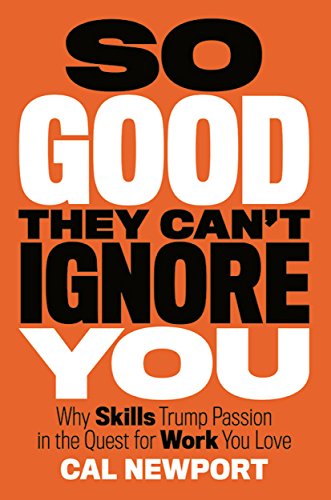
So Good They Can't Ignore You: Why Skills Trump Passion in the Quest for Work You Love, by Cal Newport

So Good They Can't Ignore You: Why Skills Trump Passion in the Quest for Work You Love, by Cal Newport


So Good They Can't Ignore You: Why Skills Trump Passion in the Quest for Work You Love, by Cal Newport

Ebook So Good They Can't Ignore You: Why Skills Trump Passion in the Quest for Work You Love, by Cal Newport

New upgraded! The So Good They Can't Ignore You: Why Skills Trump Passion In The Quest For Work You Love, By Cal Newport from the very best writer and author is currently available below. This is the book So Good They Can't Ignore You: Why Skills Trump Passion In The Quest For Work You Love, By Cal Newport that will make your day reading becomes finished. When you are looking for the printed book So Good They Can't Ignore You: Why Skills Trump Passion In The Quest For Work You Love, By Cal Newport of this title in the book establishment, you could not locate it. The problems can be the limited versions So Good They Can't Ignore You: Why Skills Trump Passion In The Quest For Work You Love, By Cal Newport that are given in the book establishment.

Occasionally, reviewing So Good They Can't Ignore You: Why Skills Trump Passion In The Quest For Work You Love, By Cal Newport is very uninteresting as well as it will certainly take long time starting from obtaining guide and also begin reading. Nonetheless, in contemporary period, you could take the creating innovation by utilizing the net. By net, you could see this page and also begin to look for the book So Good They Can't Ignore You: Why Skills Trump Passion In The Quest For Work You Love, By Cal Newport that is needed. Wondering this So Good They Can't Ignore You: Why Skills Trump Passion In The Quest For Work You Love, By Cal Newport is the one that you require, you can opt for downloading and install. Have you comprehended how you can get it?

After downloading the soft documents of this So Good They Can't Ignore You: Why Skills Trump Passion In The Quest For Work You Love, By Cal Newport, you could begin to review it. Yeah, this is so pleasurable while someone needs to review by taking their huge books; you remain in your brand-new method by just handle your gizmo. Or perhaps you are working in the workplace; you could still use the computer system to check out So Good They Can't Ignore You: Why Skills Trump Passion In The Quest For Work You Love, By Cal Newport completely. Of course, it will certainly not obligate you to take lots of web pages. Merely page by page relying on the time that you have to check out So Good They Can't Ignore You: Why Skills Trump Passion In The Quest For Work You Love, By Cal Newport

After knowing this very easy way to read as well as get this So Good They Can't Ignore You: Why Skills Trump Passion In The Quest For Work You Love, By Cal Newport, why don't you tell to others regarding by doing this? You could inform others to visit this internet site as well as go for browsing them preferred publications So Good They Can't Ignore You: Why Skills Trump Passion In The Quest For Work You Love, By Cal Newport As known, below are lots of listings that offer numerous type of books to collect. Just prepare few time as well as web connections to get the books. You could truly appreciate the life by reading So Good They Can't Ignore You: Why Skills Trump Passion In The Quest For Work You Love, By Cal Newport in a quite simple manner.

So Good They Can't Ignore You: Why Skills Trump Passion in the Quest for Work You Love, by Cal Newport

In this eye-opening account, Cal Newport debunks the long-held belief that "follow your passion" is good advice. Not only is the cliché flawed -- preexisting passions are rare and have little to do with how most people end up loving their work -- but it can also be dangerous, leading to anxiety and chronic job hopping.

After making his case against passion, Newport sets out on a quest to discover the reality of how people end up loving what they do. Spending time with organic farmers, venture capitalists, screenwriters, freelance computer programmers, and others who admitted to deriving great satisfaction from their work, Newport uncovers the strategies they used and the pitfalls they avoided in developing their compelling careers.

Matching your job to a preexisting passion does not matter, he reveals. Passion comes after you put in the hard work to become excellent at something valuable, not before.
In other words, what you do for a living is much less important than how you do it.

With a title taken from the comedian Steve Martin, who once said his advice for aspiring entertainers was to "be so good they can't ignore you," Cal Newport's clearly written manifesto is mandatory reading for anyone fretting about what to do with their life, or frustrated by their current job situation and eager to find a fresh new way to take control of their livelihood. He provides an evidence-based blueprint for creating work you love.
SO GOOD THEY CAN'T IGNORE YOU will change the way we think about our careers, happiness, and the crafting of a remarkable life.

  • Sales Rank: #17004 in eBooks
  • Published on: 2012-09-18
  • Released on: 2012-09-18
  • Format: Kindle eBook

Review
"Stop worrying about what you feel like doing (and what the world owes you) and instead, start creating something meaningful and then give it to the world. Cal really delivers with this one."

--Seth Godin, author, Linchpin

"Entrepreneurial professionals must develop a competitive advantage by building valuable skills. This book offers advice based on research and reality--not meaningless platitudes-- on how to invest in yourself in order to stand out from the crowd. An important guide to starting up a remarkable career."

--Reid Hoffman, co-founder & chairman of LinkedIn and co-author of the bestselling The Start-Up of You: Adapt to the Future, Invest in Yourself, and Transform Your Career

"Do what you love and the money will follow' sounds like great advice -- until it's time to get a job and disillusionment quickly sets in. Cal Newport ably demonstrates how the quest for 'passion' can corrode job satisfaction. If all he accomplished with this book was to turn conventional wisdom on its head, that would be interesting enough. But he goes further -- offering advice and examples that will help you bypass the disillusionment and get right to work building skills that matter."

--Daniel H. Pink, bestselling author of Drive and A Whole New Mind

"This book changed my mind. It has moved me from 'find your passion, so that you can be useful' to 'be useful so that you can find your passion.' That is a big flip, but it's more honest, and that is why I am giving each of my three young adult children a copy of this unorthodox guide."

--Kevin Kelly, Senior Maverick, WIRED magazine


"First book in years I read twice, to make sure I got it. Brilliant counter-intuitive career insights. Powerful new ideas that have already changed the way I think of my own career, and the advice I give others."

--Derek Sivers, founder, CD Baby

"Written in an optimistic and accessible tone, with clear logic and no-nonsense advice, this work is useful reading for anyone new to the job market and striving to find a path or for those who have been struggling to find meaning in their current careers."

--Publishers Weekly

About the Author

Cal Newport, PhD, is a writer and an assistant professor of computer science at Georgetown University. He also runs the popular website Study Hacks: Decoding Patterns of Success.


Dave Mallow has worked extensively in animation, video games, and audiobook narration. Among his animation credits are the voice of Baboo in Mighty Morphin Power Rangers; Angemon, Gekkomon, and Uppamon in Digimon: Digital Monsters; and Akuma in Street Fighter.

Most helpful customer reviews

506 of 524 people found the following review helpful.
Don't ignore this book
By J. F. Malcolm
I've been following Cal Newport's ideas for a while now, so when I learned that he was coming out with a book, I pre-ordered it from Amazon. I was not disappointed. If you have a child or know someone in college who is trying to figure out what to do with their life, or even if you're north of fifty and still wonder what you'll be when you grow up, then this book is for you. So Good They Can't Ignore You, is so good that you shouldn't ignore it.

The central premise that sets this book apart from so much life advice that is out on the market is that following your passion is terrible advice. There are two main reasons for this: first, very few people at a young age know enough about life to choose something to be really passionate about, and even if they do, they are bound to be wrong. If Steve Jobs had followed his early passion, maybe he would have made a dent in the universe as a Buddhist monk.

Second, while most people would love to have a job that allows them to be creative, make an impact on the world, and have control over how they choose to spend their time, jobs like that are rare and valuable, and the only way to get something valuable is to offer something in return. And the only way to be in a position to do that is to master a difficult skill. Passion doesn't waive the laws of economics, and if it's not difficult it won't be rare. The book cites the example of Julia, who quit a secure job in advertising to pursue her passion of teaching yoga. Armed with a 4-week course, she quit her job, began teaching, and one year later was on food stamps. Here's a hint: if a four-week course is enough to allow you to set up shop, do you think you might have a little competition?

Taking the economic model a step further, the book argues that you must develop career capital, which comprises skills, relationships and a body of work. The long and arduous process of building your capital also opens up your options and refines your own understanding of what you really like to do and what you can be good at.

Newport offers the craftsman mindset in place of the passion mindset. The passion mindset asks what the world can offer you in terms of fulfillment and fun; the craftsman mindset forces you to look inside and ask what you can offer the world. You have to create value to get value, and that takes time and deliberate practice. It's the only way to get so good that they can't ignore you. The nice benefit is that rather than being good at something because you love it, you love doing something because you've gotten good at it. (Note the similarity to Carol Dweck's growth mindset.)

What's the little idea? Another idea that Newport challenges is the common advice that you should have a big idea--set a big hairy audacious goal for your life and then work backward from it. The master plan approach certainly works for some people, but how many people do you know who have actually lived their lives that way? Instead, you should work forward from where you are, taking small steps that expand your capabilities and build up your career capital. In this way, more options and possibilities open up. Newport compares career discoveries to scientific discoveries, most of which occur in what's called the "adjacent possible", or just on the other side of the cutting edge of current knowledge.

The book is well-written. Newport emulates Malcolm Gladwell's technique of telling individual stories to illustrate the main point in each chapter. In addition, the arc of the stories follows a master story thread through the book, so that you feel like you are brought along on his quest to figure it all out.
Here comes the part I did not like about the book, and I would not devote so much space to it if the author were not an MIT PhD, just beginning his career as an assistant professor of computer science.

The methodology in the book is suspect in two ways. While its stories are the book's great strength, the plural of anecdote is not data, and it's surprising how little hard data we're given. I certainly buy in because it makes sense and it matches my own life experience, but someone with a more skeptical point of view may be a tougher sell.

In at least one case, where he does use a peer-reviewed study for support, he overstates the case. Citing a paper by Amy Wrzesniewski, he states that the happiest, most passionate employees are not those who followed their passion into a position, but those who stayed around long enough to be good at what they do. If you read the actual paper, you won't find that conclusion, and in fact the author stresses that the sample size of 24 is too small to draw any firm conclusions.

That said, I strongly recommend this book to just about anyone, regardless of where you are in your career.

114 of 122 people found the following review helpful.
Don't give up your passions.
By Blake Boles
So Good They Can't Ignore You is a book I've been ignoring for a long time.

Published in 2012, the book's author Cal Newport—author of How to Become a Straight-A Student, How to Be a High School Superstar, How to Win at College—struck me as suspiciously straight-laced and unquestioning of traditional education. A brief examination of his personal story revealed an extremely high-achieving, productivity-obsessed Ivy League graduate who seemed to have played by all the rules, profited handsomely, and now peddled the idea that "following your passion is dangerous advice" (the central theme of his book). This felt like a book I could indeed ignore. It's also possible that I wanted to avoid confronting criticism of my own 2012 book, Better Than College, which promoted the "follow your passion" philosophy.

But over the years I also noticed that Cal writes an insightful blog and seems like a genuinely good person. He's received endorsements from many authors who I admire and have endorsed my own work: Daniel Pink, Derek Sivers, Seth Godin, and Ben Casnocha. And, I had to admit, the "don't follow your passion" thesis compelled me by the sheer virtue of its contrarianism. I bought the Kindle edition and read it in 2 days.

Here’s the deal: Newport’s book makes valid points that will help recent graduates and mid-career professionals think about their next big moves. But its central thesis—that following your passion is a bad idea—is dangerously oversimplified. The real message in this book is: when you follow your passions, make well-informed decisions instead of impulsive ones.

Newport begins with the story of a young man named Thomas who, having obtained degrees in philosophy, theology, and religion, travels the world and becomes increasingly passionate about Zen Buddhism. He throws himself into this pursuit by joining a monastery in upstate New York where he lives ascetically and struggles to solve Zen koans. But after solving an especially tricky koan, Thomas realizes that “the undiluted peace and happiness that had populated his daydreams” hadn’t materialized. On this, Newport comments:

"Thomas had followed his passion to the Zen Mountain Monastery, believing, as many do, that the key to happiness is identifying your true calling and then chasing after it with all the courage you can muster. But as Thomas experienced that late Sunday afternoon in the oak forest, this belief is frighteningly naïve. Fulfilling his dream to become a full-time Zen practitioner did not magically make his life wonderful."

After reading it twice, I still don’t understand why Newport chose this tale to open his book. Is he arguing that “following your passion” always works out—that there aren’t dead-ends or unforeseen realizations along life’s path?

In the end of the book we learn that Thomas leaves the monastery and returns to the lowly data entry job that he hated just a few years ago. But now:

"…he approached his working life with a new awareness. His experience at the monastery had freed him from the escapist thoughts of fantasy jobs that had once dominated his mind. He was able instead to focus on the tasks he was given and on accomplishing them well. He was free from the constant, draining comparisons he used to make between his current work and some magical future occupation waiting to be discovered."

Thomas excels at his new career, receiving multiple promotions and becoming a computer systems manager for some giant company.

I’m sorry, but I don’t see where Thomas went wrong here. He developed an informed passion for Buddhism over many years, gave the “big time” a shot, and it didn’t work out. He then transitioned to a more traditional career where he likely excelled due to the mental training he received at the monastery and the generally rigorous way he followed his interest in eastern religion. As an opening salvo against following one’s passion, I think it’s an incredibly weak example.

Okay, we can’t spend all our time on the Introduction. Newport’s book does have a lot of good advice to offer, mixed in with the dubious.

In chapter one, Newport defines his enemy, the Passion Hypothesis:

"The key to occupational happiness is to first figure out what you’re passionate about and then find a job that matches this passion."

He correctly identifies that this hypothesis is a sort of secular religion in America. We—at least, we who come from generally liberal households with high levels of education, as I suspect Newport did—are told from a young age to do what we love and the money will follow and that happiness means following your passion. I completely agree.

Now Newport begins his attack, arguing that following your passion might just be terrible advice. He cites the story of Steve Jobs, who many revere as a guru of passion-seeking, thanks to his wildly popular 2005 Stanford commencement speech. Jobs wasn’t actually passionate about technology and entrepreneurship, Newport argues, but rather a spiritual seeker who “[dabbled] in electronics only when it promised to earn him quick cash” and only started Apple because he was in the right place at the right time and connected to the right people (most notably Steve Wozniak). Newport concludes:

"If a young Steve Jobs had taken his own advice and decided to only pursue work he loved, we would probably find him today as one of the Los Altos Zen Center’s most popular teachers."

Really? Isn’t it possible that the “work he loved” was exactly what Jobs ended up doing—and that’s why he did it? Newport seems to assume that any idealistic interest (in eastern religion, for example) that doesn’t lead to marketable job skills is some sort of dangerous distraction. But I think an equal argument can be made—and Newport later makes it himself—that such interests, passions, and side-projects are exactly what lead us to unique and meaningful career opportunities. Newport fails to cite the famous story of Jobs’ inspiration for developing Apple’s font faces, which came from the calligraphy class he audited after dropping out of Reed College. More pure an example of following your passion cannot be found, and this directly led to a key competitive feature in the future Apple computer. Again, Newport’s chosen story doesn’t seem to back up his thesis, and sometimes it actively opposes it.

In chapter two, Newport argues that compelling careers have complex origins that don’t neatly follow a “just go follow your passion” storyline, which is generally useful advice for any highly optimistic young person. He then summarizes some relevant findings in social science research, telling us that:

1. "Most young people say they have passions, but they’re often related to sports, dance, reading, and other not-highly-marketable interests. (Is this surprising?)"
2. “…the happiest, most passionate employees are not those who followed their passion into a position, but instead those who have been around long enough to become good at what they do.”
3. "To feel self-motivated at work you need three things: Autonomy (the feeling that you have control over your day, and that your actions are important), Competence (the feeling that you are good at what you do), and Relatedness (the feeling of connection to other people)."

The third finding is that of Self-Determination Theory—the same research that Daniel Pink masterfully summarized in his book Drive—and its “Competence” feature neatly encompasses the second research finding: people who are good at their work enjoy it more. This is all good stuff to be aware of as a career-seeker.

Newport points out that “passion” doesn’t appear in any of this research, and therefore “working right [i.e. finding a job that offers autonomy, competence, and relatedness] trumps finding the right work.” I agree, but I don’t buy Newport’s implicit argument that following your interests will necessarily lead you away from such quality work. He seems to think that following one’s passion is a childish act undertaken by those naively seeking instant career happiness. Why does he make such a sweeping assumption? The clues come in the next chapter.

Chapter three neatly summarizes the history of the “follow your passion” meme, which was birthed at the same time as the cultural revolution of the late 60’s (unsurprisingly) and nicely correlates with the success of Richard Bolles’ famous career book What Color Is Your Parachute? Newport’s analysis of this book’s significance is illuminating:

"Parachute, in other words, helped introduce the baby boom generation to this passion-centric take on career, a lesson they have now passed down to their children, the echo boom generation, which has since raised the bar on passion obsession. This young generation has 'high expectations for work,' explains psychologist Jeffrey Arnett, an expert on the mindset of the modern postgrad. 'They expect work to be not just a job but an adventure[,]… a venue for self-development and self-expression[,]… and something that provides a satisfying fit with their assessment of their talents.'"

Let’s pause here for a moment and ask: What the hell is wrong with this? Isn’t this a wonderful thing? As our cultures and economies have developed, more people have been given the chance to do work that’s meaningful to them, instead of just spending another day in the coal mines. Isn’t this something to be celebrated?

Newport isn’t sure. He argues:

"The more I studied the issue, the more I noticed that the passion hypothesis convinces people that somewhere there’s a magic 'right' job waiting for them, and that if they find it, they’ll immediately recognize that this is the work they were meant to do. The problem, of course, is when they fail to find this certainty, bad things follow, such as chronic job-hopping and crippling self-doubt."

Okay, job-hopping: maybe a bad thing, maybe not. I’m sure glad that I job-hopped relentlessly as a recent graduate, stumbling toward my current career path. And as Newport argues just a few chapters later, it’s important to “make small bets” (i.e. do small experiments) with your career in order to find a good fit. To job-hop is to make a small bet.

Crippling self-doubt: is this really only the province of people who follow their passions? What about the crippling self-doubt of those who remain on a unsatisfying career track because they’re too terrified to try something new and different? Might this doubt just be a byproduct of any life in any modern, free society that offers a limitless number of possible careers?

I think I know what you’re getting at, Cal. If you always live life with a “grass is greener on the other side” attitude, you’re going to suffer. And if you imagine that some mythical “better job” will suddenly make you happy (or make “work” not feel like “work”), then you’re going to be sorely disappointed. But these attitudes aren’t remedied the pursuit of interests and passions, they’re remedied by studying philosophy (especially eastern philosophy), surrounding yourself with good role models, and simply getting older and gaining life experience. It’s unfair to paint the entire idea of “follow your passion” in such a negative light. As a simplistic prescription, yes, it might be dangerous advice; but the opposite advice might be even more dangerous. Better, I believe, to keep the “follow your passion” meme and temper it with realistic assessments of the time, effort, and luck required to create such a life. (And perhaps that’s exactly the point of this book.)

The really good stuff in Newport’s book starts in chapter four, where he starts offering positive advice for how to find and build a satisfying career. He begins by defining the Craftsman Mindset:

"[The Craftsman Mindset] asks you to leave behind self-centered concerns about whether your job is just right, and instead put your head down and plug away at getting really damn good. No one owes you a great career, it argues; you need to earn it—and the process won’t be easy."

This is the beginning of Newport’s focus on the importance of building rare and valuable career skills: skills that make you “so good they can’t ignore you,” in the words of actor and comedian Steve Martin. (The “they” in that sentence means employers and clients.) I completely agree with this part of Newport’s argument, and it meshes with my own career experiences.

I’m also a fan of Newport’s distinction between focusing on what you can offer the world (the Craftsman Mindset) and focusing on what the world can offer you (the ill-named Passion Mindset). In Better Than College I noted this distinction as the difference between Self-Directed Learning 1.0—in which you focus on learning stuff simply because it interests you—and Self-Directed Learning 2.0—in which you learn stuff and then use it to offer value to other people (as I’m doing by writing this book review, for example). “Focusing on what you can offer the world” is the essential message behind work, entrepreneurship, and adulthood in general. Newport doesn’t help his case by pigeonholing passion-followers into the opposite camp, essentially deeming them to be childish and naive. Again, why can’t these two worlds co-exist? It’s not one or the other. You can follow your passion and focus on what you can offer the world.

Chapter five offers perhaps the most concrete advice for job-seekers: his three traits that define great work.

Creativity: getting the chance to do novel work and push established boundaries.
Impact: feeling like you’re positively influencing a large number of people.
Control: being in charge of the time, location, and method of your work.

When people talk about having great jobs, meaningful work, or a satisfying work-life balance, these traits are probably what they’re describing. Through the rest of the book Newport does a good job of illustrating the value of pursuing these traits, and accurately argues that the only way you get such an awesome job is by having equally awesome skills (which he calls “career capital”) to offer in return—skills that you gain by adopting the Craftsman Mindset.

Napoleon Dynamite said it all with fewer words:[...]

Newport takes a break to cherry-pick another unhelpful story of passion-seeking: that of Lisa Feuer, a 38-year-old woman working unhappily in advertising who quit her job, took a 200-hour yoga instructor course, and then opened a yoga practice focused on young children and pregnant women which folded at the same time as the 2009 recession—at which point Feuer apparently ended up going on food stamps. Jesus, Newport, get off it! This is not a good example! Feuer may have impulsively entered a crowded marketplace with a minimum of training, and perhaps that was her downfall. Or perhaps she embraced the Craftsman Mindset and her business model was sound, and the recession just took the wind out of its sails. Instead of making this anecdote representative of everyone who follows their passions, use it to point out that jumping into something risky (like starting a business) with lots of optimism but little training is a dicey proposition. Or sometimes forces outside our control can sink best-laid plans. Counsel preparation and moderation; don’t throw the baby out with the bathwater.

What about people in truly dumb, bad, or meaningless jobs? Should they forsake day-to-day workplace satisfaction in order to build “career capital?” Luckily, Newport lands on the right side of the fence on this question. His three disqualifiers for applying the Craftsman Mindset include:

1. "The job presents few opportunities to distinguish yourself by developing relevant skills that are rare and valuable."
2. "The job focuses on something you think is useless or perhaps even actively bad for the world."
3. "The job forces you to work with people you really dislike."

Drawing an illustration from his own life, Newport explains that when he was a computer scientist at MIT, he turned down many offers from Wall Street headhunters who wanted to hire him because such banking jobs triggered the second disqualifier. Now, wouldn’t we call this a “values mismatch?” Might we even conclude that Newport wasn’t passionate about banking or its effects on the world? Ever cautious to not contradict his own theory, Newport notes:

"…these disqualifying traits still have nothing to do with whether a job is the right fit for some innate passion."

Hmm. This begs the question, what exactly is an “innate passion?” We never get a concrete definition in the book. But let’s not go down that rabbit hole. I like Newport’s three disqualifiers, and they serve as a valuable litmus test for anyone asking herself, “Should I get the hell out of this job, even if I’m making a lot of money?”

In chapter six, Newport shares the full stories of a 31-year-old television writer and 29-year-old venture capitalist who he believes exemplify the Craftsman Mindset. The stories are inspiring illustrations of how a few young guys climbed highly competitive career ladders. But at this point in the book, something else started stealing my attention: the realization that virtually all of Newport’s case studies are high-achieving Ivy League graduates that seem to come from very comfortable backgrounds (you start to get this feeling when the someone “spends his summers with his family on an island in Maine”). Newport seems to fit this profile, too.

Now, there’s nothing wrong with writing for a specific audience, and I realize that as an author of a book like this, you’re writing first and foremost for yourself (and people like you). In my own books about alternative education, I’ve made the assumption that families have certain middle-class resources at their disposal. But I felt that in Newport’s book in particular, there was an elephant in the room, namely: “this book only pertains to you if you’re an Ivy League graduate with great family resources at your disposal.” No one outside this demographic was mentioned in the book.

Chapter seven is dedicated to explaining deliberate practice, an important psychology finding about which I’ve written in two of my books. Newport shines here. (Search his blog for more good writing on deliberate practice.) In essence: to build real skills and “career capital,” you have to work your butt off. Most people don’t like working their butts off. So if you can master deliberate practice, you’ll build mad skills and quickly separate yourself from the pack. This is all good and true.

Chapters eight through eleven dwell on the Control factor that we encountered back in the three traits that define great work. Newport reviews why having control over the time and place of your work is important (I’m a believer!) and examines the potential “traps” of pursuing such control:

1. Jumping into a high-control situation (e.g. starting a business) without enough real skills or experience
2. Dealing with resistance from employers who want to keep you around when you do develop valuable skills/experience
3. Making sure that people will actually pay for your service/business before you start it.

Strangely absent from this chapter is a discussion of the virtues and drawbacks of self-employment. Most of those who pursue Control do so by starting their own businesses, but Newport doesn’t explicitly name self-employment as a way to achieve Control. Much of the book is couched in the language of “jobs” and employer/employee, but some of its best case studies feature self-employed people. Strange.

Chapter twelve argues in favor of having a mission: “a unifying focus for your career.” I agree. But doesn’t this sound suspiciously like having a “passion” that guides your career? Pay no heed. Newport argues you can’t really figure out a mission until you’ve accumulated a bunch of career capital. Which is another way of saying that experience helps us make informed decisions and better understand a domain. Yup, got it. Again, this advice doesn’t conflict with the “follow your passion” model; it simply adds a disclaimer: “follow your passion, but not just one that lives in your head. Pay attention to the real world around you.”

Chapter thirteen talks more about mission, and Newport makes a really good point:

"If you want to identify a mission for your working life. . . you must first get to the cutting edge—the only place where these missions become visible."

Choosing a good mission (or passion) is difficult if you don’t know what’s already been done. Here Newport argues for building domain knowledge (e.g. in my case, learning the ins and outs of the world of alternative education) before deciding where to make your mark. This is solid advice, and it’s especially relevant to aspiring entrepreneurs. We cannot magically will ourselves into understanding what other people (or “the world”) needs; we must work, learn, and meet people to gain that understanding, and that takes time. Along the way, you might as well do the best work possible and gain rare and valuable skills which will open doors for you. That’s my distillation of these chapters.

Chapter fourteen introduces the concept of making “little bets”, i.e. doing lots of mini-experiments in your career that might lead to bigger opportunities. This is essentially the design process applied to one’s career. Instead of choosing some big, pie-in-the-sky goal for your career (i.e. making a “big bet”), go explore different possibilities, develop side projects, get feedback on them, and expect that most will fail. Good advice.

Chapter fifteen is about marketing, and it can be boiled down into one sentence: Do interesting stuff, because other people like you more when you’re interesting. Yup. This didn’t require a “law of remarkability.” (The book has enough self-proclaimed “laws” and “rules” already.)

So Good They Can’t Ignore You concludes with Newport’s own story of achieving an assistant professorship at Georgetown University. He relates stories from his childhood that paint a picture of a precocious youth—he and his friend started a web design company in the late 90’s that landed contracts between $5,000-$10,000—and his incredible personal drive during college at Dartmouth, where he got perfect grades, published student-advice guides, and was hounded by calls from a literary agent. His is a story of a genuinely, almost freakishly hard worker, and someone with a very analytical and austere mindset. I'd put money on his Myers-Briggs type being INTJ. I don't get the sense that Cal Newport has much sympathy for romantics or idealists.

This book will most benefit those much like Newport: organized, serious, intellectual, and ambitious young people who find themselves bound for the Ivy Leagues and traditional, high-achieving and highly paid careers. And even for those who don't fit this mold, Newport’s book offers valuable insights, perhaps most importantly his invocation to look before you leap into a “dream job” that you imagine will make you happy—patience and diligent work might be what you need more than idealistic courage. Newport properly reminds you to be prepared to suck up lame responsibilities in entry-level jobs and to build real skills and “career capital” before striking out on your own. But do you need give up on following your passions in the process? No way. Newport's book failed to convince me of its central thesis. Don't give up your passions. Instead, read this book to temper your idealism with basic, common-sense career-building strategies.

This review was originally published on blakeboles dot com.

8 of 8 people found the following review helpful.
Newport got it wrong - but it's still a good read. :)
By Lauchlan Mackinnon, Ph.D.
Overall, this was a good book with some provocative original ideas - but with some deep flaws.

THE GOOD

I think Newport made a great original contribution to understanding career development with his concept of Career Capital:

"The traits that define great work are rare and valuable. Supply and demand says that if you want [this work] you need rare and valuable skills to offer in return. Think of these rare and valuable skills you can offer as your career capital. The craftsman mindset, with its relentless focus on becoming “so good they can’t ignore you,” is a strategy well suited for acquiring career capital. "

Newport suggests a strategy of acquiring career capital - and then investing it in better roles.

To develop career capital,

* develop a craftsman attitude
* start "deliberative practice" - "Deliberate practice is the key strategy for acquiring career capital then integrating it into your own working life." As per the 10,000 hours philosophy espoused by Anders Ericsson and then Malcolm Gladwell..

To get more career control, understand the two control traps:

The First Control Trap
"Control that’s acquired without career capital is not sustainable."

The Second Control Trap
"The point at which you have acquired enough career capital to get meaningful control over your working life is exactly the point when you’ve become valuable enough to your current employer that they will try to prevent you from making the change."

Then, develop your mission by getting to the cutting edge of your field and spotting what is possible in the adjacent future.

THE (VERY) BAD:

In spite of the good in the book, I think Newport made several major mistakes that radically reduced the forcefulness of his book's argument.

I just want to tackle one of them here, which is his attack on the "passion hypothesis."

The Passion Hypothesis is stated as:
"The key to occupational happiness is to first figure out what you’re passionate about and then find a job that matches this passion."

Then Newport proceeds to tell us why this hypothesis is wrong.

Unfortunately, this "passion hypothesis" is a straw man, an artificial construction created by Newport.

According to Newport, the poster child for the passion hypothesis is Richard Bolles and his book "What Color is Your Parachute."

Newport however seems to have completely missed the point of Bolles' book - and the central point of similar books in this genre.

"Passion" was not what was at the core of Bolles' book. In fact, the word "passion" was rarely mentioned in the book.

Instead, Bolles advocated an alignment between Skills, "Knowledges," and (in different editions) either Values or Purpose, together with conceptualising an ideal work environment.

** Bolles' book placed skills at the very centre of his approach **.

For Bolles, 'skills' were NOT ignored. They were the very foundation.

To say Bolles' approach was just about "following your passion" - and doing so at the expense of skills - is either a deliberate mischaracterisation of Bolles' work, or shows an astonishingly low level of understanding of the point of view that Newport is attacking.

And it's not just Bolles who took this skills-based approach to career and business development.

Most of the common models in the 'find your career' or 'do work you love' or 'start your business' genres tend to follow something like the Jim Collins Hedgehog model - combine what you love (your interests or passions) with what you're good at (your skills and strengths) and a market need.

** For Newport to put passion VS skills as a dichotomy where you have to choose one or the other and can't have both is not representative of what people actually teach or what career seekers or business startups actually do. **

It is a false dichotomy.

In the examples he used in the book, this was so ridiculous that at one point (Ch. 5) Newport even observed his example wasn't really all that representative, and that we should understand the case examples forming the foundation of the chapter as simply a good 'metaphor.'

This isn't just a minor point. This is a gaping hole in the fundamental premise in the book - that other people tell you to just go and follow your passion, that that's wrong, and Newport alone has a different and better way.

Well, Newport's way - to focus on skills development - is along the lines what everyone else does anyway.

Newport makes some good contributions about the process of developing your skills and using them to advance your career. But his rhetorical positioning that everyone else is just about following your passion and only he can show us the 'true path' is plain wrong.

I do recommend reading this book as it has some good ideas and for me it generated some good reflections. Just be aware that there is a gaping hole in his premise around the role that passion plays in career development. And that he uses the same rhetorical device of constructing and attacking a false 'straw man' in his next book, Deep Work - so this seems to be a deliberate strategy or preference on Newport's part.

See all 447 customer reviews...

So Good They Can't Ignore You: Why Skills Trump Passion in the Quest for Work You Love, by Cal Newport PDF
So Good They Can't Ignore You: Why Skills Trump Passion in the Quest for Work You Love, by Cal Newport EPub
So Good They Can't Ignore You: Why Skills Trump Passion in the Quest for Work You Love, by Cal Newport Doc
So Good They Can't Ignore You: Why Skills Trump Passion in the Quest for Work You Love, by Cal Newport iBooks
So Good They Can't Ignore You: Why Skills Trump Passion in the Quest for Work You Love, by Cal Newport rtf
So Good They Can't Ignore You: Why Skills Trump Passion in the Quest for Work You Love, by Cal Newport Mobipocket
So Good They Can't Ignore You: Why Skills Trump Passion in the Quest for Work You Love, by Cal Newport Kindle

So Good They Can't Ignore You: Why Skills Trump Passion in the Quest for Work You Love, by Cal Newport PDF

So Good They Can't Ignore You: Why Skills Trump Passion in the Quest for Work You Love, by Cal Newport PDF

So Good They Can't Ignore You: Why Skills Trump Passion in the Quest for Work You Love, by Cal Newport PDF